1 – A partir de son centre et de son rayon
Propriété 1 : On considère un point \(A(x_A\,;\,y_A)\) et un nombre réel \(R > 0\).
Le cercle \((\mathcal{C})\) de centre \(A\) et de rayon \(R\) est l'ensemble des points \(M(x\,;\,y)\) tel que : \[(x - x_A)^2 + (y - y_A)^2 = R^2\]
Le cercle \((\mathcal{C})\) de centre \(A\) et de rayon \(R\) est l'ensemble des points \(M(x\,;\,y)\) tel que : \[(x - x_A)^2 + (y - y_A)^2 = R^2\]
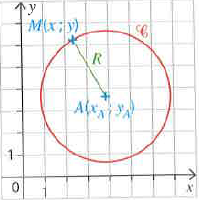
Remarques :
• L'égalité précédente est appelée une équation cartésienne du cercle \((\mathcal{C})\).
• Réciproquement, l'ensemble des points \(M(x\,;\,y)\) vérifiant l'équation \((x - a)^2 + (y - b)^2 = S\) où \(S > 0\), est un cercle de centre \((a\,;\,b)\) et de rayon \(\sqrt{S}\).
• L'égalité précédente est appelée une équation cartésienne du cercle \((\mathcal{C})\).
• Réciproquement, l'ensemble des points \(M(x\,;\,y)\) vérifiant l'équation \((x - a)^2 + (y - b)^2 = S\) où \(S > 0\), est un cercle de centre \((a\,;\,b)\) et de rayon \(\sqrt{S}\).
Démonstration :
Soit \(\mathcal{C}\) le cercle de centre \(A(x_A\,;\,y_A)\) et de rayon \(R > 0\).• \[\begin{aligned} M(x\,;\,y) \in \mathcal{C} &\Leftrightarrow AM = R \Leftrightarrow AM^2 = R^2 \\ &\Leftrightarrow \lVert\overrightarrow{AM}\rVert^2 = R^2 \end{aligned}\]
• Or, \(\overrightarrow{AM}\begin{pmatrix} x_M - x_A \\ y_M - y_A \end{pmatrix} = \begin{pmatrix} x - x_A \\ y - y_A \end{pmatrix}\) d'où \(\lVert\overrightarrow{AM}\rVert^2 = (x - x_A)^2 + (y - y_A)^2\).
• Ainsi, \(M(x\,;\,y) \in (\mathcal{C}) \Leftrightarrow (x - x_A)^2 + (y - y_A)^2 = R^2\).
• Cela prouve que \((\mathcal{C})\) a pour équation cartésienne l'égalité précédente. \(\square\)
Exemple 1 :
Vérifier que le cercle \((\mathcal{C})\) de centre \(A(4\,;\,-1)\) et de rayon \(3\) a pour équation cartésienne :
\[(\mathcal{C}) : x^2 + y^2 - 8x + 2y + 8 = 0\]
• D'après la propriété 1, \(\mathcal{C}\) est l'ensemble des points \(M(x\,;\,y)\) tels que \((x - 4)^2 + (y + 1)^2 = 3^2\).
• En développant, on obtient \((\mathcal{C}) : x^2 - 8x + 16 + y^2 + 2y + 1 = 9\) d'où \((\mathcal{C}) : x^2 + y^2 - 8x + 2y + 8 = 0\).
2 – A partir de son diamètre
Propriété 2 : On considère deux points \(A(x_A\,;\,y_A)\) et \(B(x_B\,;\,y_B)\).
Le cercle \(\mathcal{C}\) de diamètre \([AB]\) a pour équation cartésienne : \[(\mathcal{C}) : (x - x_A)(x - x_B) + (y - y_A)(y - y_B) = 0\]
Le cercle \(\mathcal{C}\) de diamètre \([AB]\) a pour équation cartésienne : \[(\mathcal{C}) : (x - x_A)(x - x_B) + (y - y_A)(y - y_B) = 0\]
![Cercle de diamètre [AB] dans un repère](/static/zmaths/images/cours/1spe-g3-2-02.png)
Remarque : On peut aussi calculer les coordonnées du milieu \(I\) de \([AB]\) ainsi que la valeur du rayon \(IA\).
Démonstration :
Soit \((\mathcal{C})\) le cercle de diamètre \([AB]\).• \[\begin{aligned} M(x\,;\,y) \in (\mathcal{C}) &\Leftrightarrow \overrightarrow{MA}.\overrightarrow{MB} = 0 \\ &\Leftrightarrow \overrightarrow{AM}.\overrightarrow{BM} = 0 \end{aligned}\]
Or \(\overrightarrow{AM}\begin{pmatrix} x - x_A \\ y - y_A \end{pmatrix}\) et \(\overrightarrow{BM}\begin{pmatrix} x - x_B \\ y - y_B \end{pmatrix}\).
• Ainsi, \[M(x\,;\,y) \in (\mathcal{C}) \;\Leftrightarrow\; (x - x_A)(x - x_B) + (y - y_A)(y - y_B) = 0\]
• Cela prouve que \((\mathcal{C})\) a pour équation cartésienne l'égalité précédente. \(\square\)
Exemple 2 :
Soient \(A(2\,;\,-4)\) et \(B(3\,;\,1)\). Le point \(M(0\,;\,-1)\) appartient-il au cercle \(\mathcal{C}\) de diamètre \([AB]\) ?
• \(\mathcal{C}\) a pour équation cartésienne \((\mathcal{C}) : (x - 2)(x - 3) + (y + 4)(y - 1) = 0\).
• \((0 - 2)(0 - 3) + (-1 + 4)(-1 - 1) = 6 - 6 = 0\) donc \(M(0\,;\,-1) \in (\mathcal{C})\).
• \(\mathcal{C}\) a pour équation cartésienne \((\mathcal{C}) : (x - 2)(x - 3) + (y + 4)(y - 1) = 0\).
• \((0 - 2)(0 - 3) + (-1 + 4)(-1 - 1) = 6 - 6 = 0\) donc \(M(0\,;\,-1) \in (\mathcal{C})\).
![Cercle de diamètre [AB] avec le point M](/static/zmaths/images/cours/1spe-g3-2-03.png)