1 – Théorème de la médiane
Théorème 1 : Soient deux points \(A\) et \(B\) du plan et \(I\) le milieu du segment \([AB]\).
Pour tout point \(M\) du plan on a : \[\overrightarrow{MA}.\overrightarrow{MB} = MI^{2} - \dfrac{1}{4}AB^{2}\]
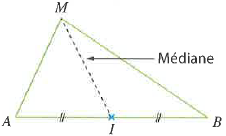
Pour tout point \(M\) du plan on a : \[\overrightarrow{MA}.\overrightarrow{MB} = MI^{2} - \dfrac{1}{4}AB^{2}\]
Démonstration :
Soient deux points \(A\) et \(B\) et \(I\) le milieu de \([AB]\). Calculons le produit scalaire \(\overrightarrow{MA}.\overrightarrow{MB}\).\[\overrightarrow{MA}.\overrightarrow{MB} = (\overrightarrow{MI} + \overrightarrow{IA}).(\overrightarrow{MI} + \overrightarrow{IB})\] On décompose à l'aide de la relation de Chasles. \[= \overrightarrow{MI}^{\,2} + \overrightarrow{MI}.\overrightarrow{IB} + \overrightarrow{IA}.\overrightarrow{MI} + \overrightarrow{IA}.\overrightarrow{IB}\] On développe à l'aide de la double distributivité. \[= \overrightarrow{MI}^{\,2} + \overrightarrow{MI}.(\overrightarrow{IA} + \overrightarrow{IB}) + \overrightarrow{IA}.\overrightarrow{IB}\] On factorise par \(\overrightarrow{MI}\). \[= \overrightarrow{MI}^{\,2} + \overrightarrow{IA}.\overrightarrow{IB}\] car \(\overrightarrow{IA} + \overrightarrow{IB} = \vec{0}\) puisque \(I\) est le milieu de \([AB]\). \[= \overrightarrow{MI}^{\,2} - \dfrac{1}{4}\overrightarrow{AB}^{\,2}\] car \(\overrightarrow{IA} = \dfrac{1}{2}\overrightarrow{BA} = -\dfrac{1}{2}\overrightarrow{AB}\) et \(\overrightarrow{IB} = \dfrac{1}{2}\overrightarrow{AB}\). \[= MI^{2} - \dfrac{1}{4}AB^{2}\] car \(\overrightarrow{AB}^{\,2} = \|\overrightarrow{AB}\|^{2} = AB^{2}\). \(\square\)
Exemple 1 :
Quelle est la longueur d'une médiane dans un triangle équilatéral de côté \(1\) ?
• Soit \(AMB\) un triangle équilatéral de côté \(1\). On a donc \(\widehat{M} = \dfrac{\pi}{3}\;(60°)\).
• \(\overrightarrow{MA}.\overrightarrow{MB} = MA \times MB \times \cos(\widehat{AMB}) = 1 \times 1 \times \dfrac{1}{2} = \dfrac{1}{2}\).
• Le théorème de la médiane nous permet d'écrire que : \(MI^{2} - \dfrac{1}{4} \times 1^{2} = \dfrac{1}{2}\).
• On obtient donc \(MI^{2} = \dfrac{1}{2} + \dfrac{1}{4} = \dfrac{3}{4}\) d'où \(MI = \sqrt{\dfrac{3}{4}} = \dfrac{\sqrt{3}}{\sqrt{4}} = \dfrac{\sqrt{3}}{2}\).
2 – Formule d'Al-Kashi
Théorème 2 : Dans un triangle \(ABC\), on pose \(a = BC\), \(b = AC\) et \(c = AB\).
On a alors : \[a^{2} = b^{2} + c^{2} - 2bc\cos(\widehat{A})\]
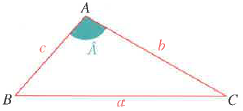
On a alors : \[a^{2} = b^{2} + c^{2} - 2bc\cos(\widehat{A})\]
Démonstration :
Soit \(ABC\) un triangle.• Exprimons \(\overrightarrow{BC}\) en fonction de \(\overrightarrow{AB}\) et \(\overrightarrow{AC}\) (Relation de Chasles) : \[\overrightarrow{BC} = \overrightarrow{BA} + \overrightarrow{AC} = -\overrightarrow{AB} + \overrightarrow{AC} = \overrightarrow{AC} - \overrightarrow{AB}\] • A l'aide de l'identité remarquable on développe \(\overrightarrow{BC}^{\,2}\) : \[\overrightarrow{BC}^{\,2} = (\overrightarrow{AC} - \overrightarrow{AB})^{2} = \overrightarrow{AC}^{\,2} - 2\overrightarrow{AC}.\overrightarrow{AB} + \overrightarrow{AB}^{\,2}\] • Or la définition du produit scalaire avec le cosinus permet d'écrire : \[\overrightarrow{AC}.\overrightarrow{AB} = AC \times AB \times \cos(\widehat{CAB})\] • On obtient : \[\begin{aligned} BC^{2} &= \overrightarrow{BC}^{\,2} \\ &= AC^{2} - 2 \times AC \times AB \times \cos(\widehat{CAB}) + AB^{2} \end{aligned}\] c'est-à-dire \(a^{2} = b^{2} + c^{2} - 2bc\cos(\widehat{A})\). \(\square\)
Remarques :
• On a aussi \(b^{2} = a^{2} + c^{2} - 2ac\cos(\widehat{B})\) et \(c^{2} = a^{2} + b^{2} - 2ab\cos(\widehat{C})\).
• Ce théorème généralise le théorème de Pythagore : si \(ABC\) est rectangle en \(A\) on a \(\widehat{A} = 90°\) et \(\cos(\widehat{A}) = 0\).
On obtient donc \(a^{2} = b^{2} + c^{2}\) c'est-à-dire \(BC^{2} = AC^{2} + AB^{2}\).
• On a aussi \(b^{2} = a^{2} + c^{2} - 2ac\cos(\widehat{B})\) et \(c^{2} = a^{2} + b^{2} - 2ab\cos(\widehat{C})\).
• Ce théorème généralise le théorème de Pythagore : si \(ABC\) est rectangle en \(A\) on a \(\widehat{A} = 90°\) et \(\cos(\widehat{A}) = 0\).
On obtient donc \(a^{2} = b^{2} + c^{2}\) c'est-à-dire \(BC^{2} = AC^{2} + AB^{2}\).
Exemple 2 :
On considère un triangle \(ABC\) tel que \(AB = 6\), \(AC = 12\) et \(\widehat{BAC} = 60°\).
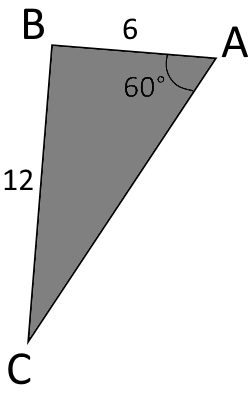
On applique Al-Kashi avec \(a = BC\) ; \(b = 12\) ; \(c = 6\) et \(\widehat{A} = 60°\) donc \(\cos(\widehat{A}) = \dfrac{1}{2}\). \[\begin{aligned} a^{2} &= b^{2} + c^{2} - 2bc\cos(\widehat{A}) \\ &= 12^{2} + 6^{2} - 2 \times 12 \times 6 \times 0{,}5 = 108 \end{aligned}\] Ainsi, \(BC^{2} = 108\) d'où \(BC = \sqrt{108} = \sqrt{36 \times 3} = 6\sqrt{3} \approx 10{,}4\).
2) Déterminer la mesure de l'angle \(\widehat{BCA}\).
On applique la formule d'Al-Kashi \(c^{2} = a^{2} + b^{2} - 2ab\cos(\widehat{C})\) pour trouver d'abord \(\cos(\widehat{C})\). \[36 = 108 + 144 - 2 \times 6\sqrt{3} \times 12 \times \cos(\widehat{C})\] \[-216 = -144\sqrt{3} \times \cos(\widehat{C})\] \[\begin{aligned} \cos(\widehat{C}) &= \dfrac{-216}{-144\sqrt{3}} = \dfrac{72 \times 3}{72 \times 2\sqrt{3}} = \dfrac{3}{2\sqrt{3}} \\[6pt] &= \dfrac{\sqrt{3} \times \sqrt{3}}{2 \times \sqrt{3}} = \dfrac{\sqrt{3}}{2} \end{aligned}\] Et donc \(\widehat{C} = 30°\). 3) Que peut-on en déduire sur le triangle \(ABC\) ?
La somme des angles d'un triangle étant égale à \(180°\) on a \(\widehat{A} + \widehat{B} + \widehat{C} = 180°\) d'où \(60° + \widehat{B} + 30° = 180°\).
Ainsi \(\widehat{B} = 180° - 60° - 30° = 90°\) et on en déduit que le triangle \(ABC\) est rectangle en \(B\).
3 – Caractérisation du cercle
Théorème 3 : On considère deux points \(A\), \(B\) du plan.
L'ensemble des points \(M\) tels que \(\overrightarrow{MA}.\overrightarrow{MB} = 0\) est le cercle de diamètre \([AB]\).
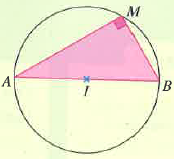
L'ensemble des points \(M\) tels que \(\overrightarrow{MA}.\overrightarrow{MB} = 0\) est le cercle de diamètre \([AB]\).
Démonstration :
Soient deux points \(A\) et \(B\) et \(I\) le milieu de \([AB]\). Soit \(M\) un point du plan.• D'après le théorème de la médiane on a \(\overrightarrow{MA}.\overrightarrow{MB} = MI^{2} - \dfrac{1}{4}AB^{2}\).
\[\begin{aligned} &\overrightarrow{MA}.\overrightarrow{MB} = 0 \;\Leftrightarrow\; MI^{2} - \dfrac{1}{4}AB^{2} = 0 \\[6pt] &\Leftrightarrow\; MI^{2} = \left(\dfrac{1}{2}AB\right)^{2} \\[6pt] &\Leftrightarrow\; MI = \dfrac{1}{2}AB \end{aligned}\] (car \(AB > 0\) et \(MI > 0\)).
• Soit \(\mathcal{C}\) le cercle de diamètre \([AB]\). \(\mathcal{C}\) est donc de centre \(I\).
• On a donc \(MI = \dfrac{1}{2}AB\) \(\Leftrightarrow\) \(MI\) est un rayon de \(\mathcal{C}\) \(\Leftrightarrow\) \(M \in \mathcal{C}\).
• Conclusion : \(\overrightarrow{MA}.\overrightarrow{MB} = 0\) \(\Leftrightarrow\) \(M\) appartient au cercle de diamètre \([AB]\), ce qui démontre le théorème. \(\square\)
Remarque : Voici une reformulation plus connue de ce théorème :
Le triangle \(AMB\) est rectangle en \(M\) (\(\overrightarrow{MA}.\overrightarrow{MB} = 0\)) si et seulement si le point \(M\) appartient au cercle circonscrit à ce triangle (le cercle de diamètre \([AB]\)).
Le triangle \(AMB\) est rectangle en \(M\) (\(\overrightarrow{MA}.\overrightarrow{MB} = 0\)) si et seulement si le point \(M\) appartient au cercle circonscrit à ce triangle (le cercle de diamètre \([AB]\)).
Exemple 3 :
Soit \(ABC\) un triangle tel que \(AB = 4\), \(AC = 3\) et \(BC = 5\).
Montrer que \(A\) appartient au cercle de diamètre \([BC]\).
• \((3\;;\;4\;;\;5)\) est un triplet pythagoricien : on a \(3^{2} + 4^{2} = 9 + 16 = 25 = 5^{2}\).
• On a donc \(AB^{2} + AC^{2} = BC^{2}\) et d'après la réciproque de Pythagore, \(ABC\) est rectangle en \(A\).
• Ainsi \(\overrightarrow{AB}.\overrightarrow{AC} = 0\) et donc d'après le théorème précédent, \(A\) appartient au cercle de diamètre \([BC]\).