1 – Limites des fonctions de références
Fonction constante
\(f(x) = k\) (où \(k\) est un réel)
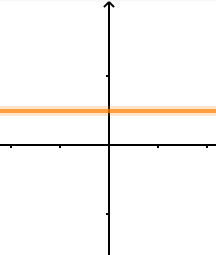
\(\lim_{x \rightarrow + \infty}{f(x)} = k\)
\(\lim_{x \rightarrow - \infty}{f(x)} = k\)
\(f(x) = k\) (où \(k\) est un réel)
\(\lim_{x \rightarrow + \infty}{f(x)} = k\)
\(\lim_{x \rightarrow - \infty}{f(x)} = k\)
Fonction identité
\(f(x) = x\)
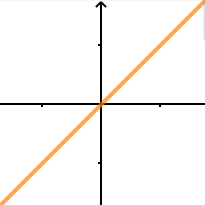
\(\lim_{x \rightarrow + \infty}{f(x)} = + \infty\)
\(\lim_{x \rightarrow - \infty}{f(x)} = - \infty\)
\(f(x) = x\)
\(\lim_{x \rightarrow + \infty}{f(x)} = + \infty\)
\(\lim_{x \rightarrow - \infty}{f(x)} = - \infty\)
Fonction carré
\(f(x) = x^2\)
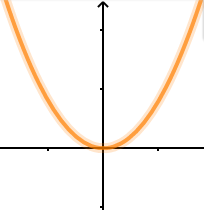
\(\lim_{x \rightarrow + \infty}{f(x)} = + \infty\)
\(\lim_{x \rightarrow - \infty}{f(x)} = + \infty\)
\(f(x) = x^2\)
\(\lim_{x \rightarrow + \infty}{f(x)} = + \infty\)
\(\lim_{x \rightarrow - \infty}{f(x)} = + \infty\)
Fonction cube
\(f(x) = x^{3}\)
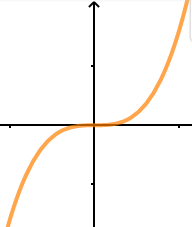
\(\lim_{x \rightarrow + \infty}{f(x)} = + \infty\)
\(\lim_{x \rightarrow - \infty}{f(x)} = - \infty\)
\(f(x) = x^{3}\)
\(\lim_{x \rightarrow + \infty}{f(x)} = + \infty\)
\(\lim_{x \rightarrow - \infty}{f(x)} = - \infty\)
Fonction racine carrée
\(f(x) = \sqrt{x}\)
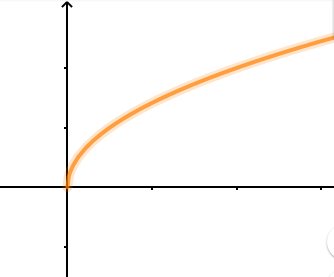
\(\lim_{x \rightarrow + \infty}{f(x)} = + \infty\)
\(\lim_{x \rightarrow 0}{f(x)} = 0\)
\(f(x) = \sqrt{x}\)
\(\lim_{x \rightarrow + \infty}{f(x)} = + \infty\)
\(\lim_{x \rightarrow 0}{f(x)} = 0\)
Fonction inverse
\(f(x) = \dfrac{1}{x}\)
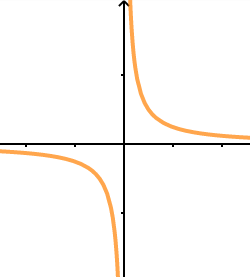
\(\lim_{x \rightarrow + \infty}{f(x)} = 0^{+}\) ; \(\lim_{x \rightarrow - \infty}{f(x)} = 0^{-}\)
\(\lim_{x \rightarrow 0^{+}}{f(x)} = + \infty\) ; \(\lim_{x \rightarrow 0^{-}}{f(x)} = - \infty\)
\(f(x) = \dfrac{1}{x}\)
\(\lim_{x \rightarrow + \infty}{f(x)} = 0^{+}\) ; \(\lim_{x \rightarrow - \infty}{f(x)} = 0^{-}\)
\(\lim_{x \rightarrow 0^{+}}{f(x)} = + \infty\) ; \(\lim_{x \rightarrow 0^{-}}{f(x)} = - \infty\)
Fonction valeur absolue
\(f(x) = |x|\)
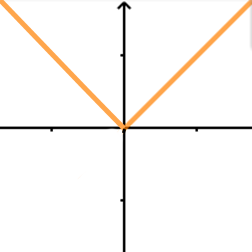
\(\lim_{x \rightarrow + \infty}{f(x)} = + \infty\)
\(\lim_{x \rightarrow - \infty}{f(x)} = + \infty\)
\(f(x) = |x|\)
\(\lim_{x \rightarrow + \infty}{f(x)} = + \infty\)
\(\lim_{x \rightarrow - \infty}{f(x)} = + \infty\)
Fonction exponentielle
\(f(x) = \text{e}^{x}\)
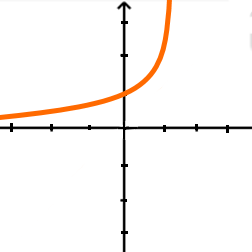
\(\lim_{x \rightarrow + \infty}{f(x)} = + \infty\)
\(\lim_{x \rightarrow - \infty}{f(x)} = 0^{+}\)
\(f(x) = \text{e}^{x}\)
\(\lim_{x \rightarrow + \infty}{f(x)} = + \infty\)
\(\lim_{x \rightarrow - \infty}{f(x)} = 0^{+}\)
Fonctions trigonométriques
\(f(x) = \cos(x)\) ou \(\sin(x)\)
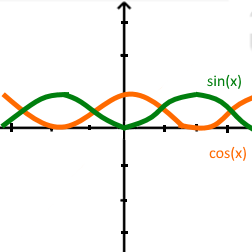
Pas de limites en \(+ \infty\)
Pas de limites en \(- \infty\)
\(f(x) = \cos(x)\) ou \(\sin(x)\)
Pas de limites en \(+ \infty\)
Pas de limites en \(- \infty\)
Remarque : Plus généralement les fonctions puissances \(f(x) = x^{n}\) ont mêmes limites que :
• La fonction carré si \(n\) est pair.
• La fonction cube si \(n\) est impair.
• La fonction carré si \(n\) est pair.
• La fonction cube si \(n\) est impair.
2 – Opérations sur les limites
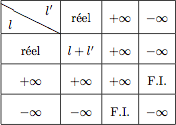
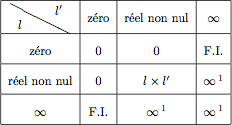
Pour calculer la limite d'une fonction complexe on utilise les mêmes règles opératoires que pour les suites. Elles sont rappelées dans les tableaux suivants et s'appliquent pour les limites en \(+ \infty\), \(- \infty\) ou en \(a \in \mathbb{R}\).
Limite d'une somme
Limite d'un produit
Limite d'un quotient
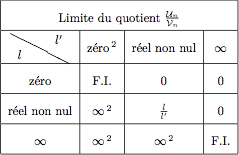
• Pour déterminer le signe de \(\infty\) on utilise la règle des signes.
• F.I. : Forme indéterminée. On doit transformer l'expression, souvent via une factorisation, pour « lever l'indétermination ».
• F.I. : Forme indéterminée. On doit transformer l'expression, souvent via une factorisation, pour « lever l'indétermination ».
Exemple 1 :
Déterminer les limites suivantes :
• \(\lim_{x \rightarrow + \infty}\left(\dfrac{1}{x} + 3\right)\)
\(= « 0^{+} » + « 3 » = 3^{+}\)
• \(\lim_{x \rightarrow - \infty}\left(x^{3} + x\right)\)
\(= « -\infty » + « -\infty » = -\infty\)
• \(\lim_{x \rightarrow 0^{+}}(x - 2) \times \dfrac{1}{x}\)
\(= « (-2)^{+} » \times « + \infty » = -\infty\)
• \(\lim_{x \rightarrow - \infty} x^{5}(1 - x^2)\)
\(= « -\infty » \times « -\infty » = + \infty\)
• \(\lim_{x \rightarrow - \infty}\dfrac{\text{e}^{x}}{x}\)
\(= \dfrac{« 0^{+} »}{« -\infty »} = 0^{-}\)
• \(\lim_{x \rightarrow 3^{+}}\dfrac{1}{x - 3}\)
\(= \dfrac{1}{« 0^{+} »} = + \infty\)
• \(\lim_{x \rightarrow - \infty} 2x^{3} + 4x^{2} + 6x - 1\)
\(= « -\infty » + « +\infty » + « -\infty » - 1\). C'est une \(F.I.\).
On factorise par \(2x^{3}\) : \(\lim_{x \rightarrow - \infty} 2x^{3} + 4x^{2} + 6x - 1\)
\(= \lim_{x \rightarrow - \infty} 2x^{3}\left(1 + \underbrace{\dfrac{2}{x} + \dfrac{3}{2x^{2}} - \dfrac{1}{x^{3}}}_{\rightarrow 0}\right)\)
\(= « -\infty » \times « 1 » = -\infty\)
• \(\lim_{x \rightarrow 1}\dfrac{x^{2} - 1}{x - 1} = \dfrac{« 0 »}{« 0 »}\).
C'est une \(F.I.\).
On factorise l'identité remarquable : \(\lim_{x \rightarrow 1}\dfrac{x^{2} - 1}{x - 1} = \lim_{x \rightarrow 1}\dfrac{(x - 1)(x + 1)}{x - 1}\)
\(= \lim_{x \rightarrow 1}(x + 1) = « 1 » + « 1 » = 2\)
Propriété 1 (Fonctions composées) : Soient \(f\) et \(u\) deux fonctions et \(a\) un nombre réel ou \(\pm \infty\).
Si \(\lim_{x \rightarrow a}{u(x)} = l\) et \(\lim_{X \rightarrow l}{f(X)} = L\) alors \(\lim_{x \rightarrow a}{f(u(x))} = L\).
Si \(\lim_{x \rightarrow a}{u(x)} = l\) et \(\lim_{X \rightarrow l}{f(X)} = L\) alors \(\lim_{x \rightarrow a}{f(u(x))} = L\).
Exemple 2 :
Déterminer les limites suivantes :
• \(\lim_{x \rightarrow + \infty} \text{e}^{1 - x}\) : Lorsque \(x \rightarrow + \infty\) on a \(1 - x \rightarrow - \infty\) et lorsque \(X \rightarrow - \infty\) on a \(\text{e}^{X} \rightarrow 0\). Donc \(\lim_{x \rightarrow + \infty} \text{e}^{1 - x} = 0\).
• \(\lim_{x \rightarrow + \infty}(2 - 3x)^{4}\) : Si \(x \rightarrow + \infty\), \(2 - 3x \rightarrow - \infty\) et si \(X \rightarrow - \infty\), \(X^{4} \rightarrow + \infty\). Donc \(\lim_{x \rightarrow + \infty}(2 - 3x)^{4} = + \infty\).
3 – Théorèmes de comparaison
Les théorèmes de comparaison énoncés pour les suites fonctionnent aussi pour les fonctions et s'appliquent pour les limites en \(+ \infty\), \(- \infty\) ou en \(a \in \mathbb{R}\).
Exemple 3 :
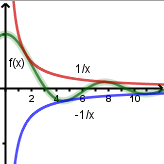
Déterminer la limite de la fonction \(f(x) = \dfrac{\sin x}{x}\) en \(+ \infty\).
Pour tout réel \(x\), on a \(-1 \leq \sin x \leq 1\), d'où en divisant par \(x > 0\), \(-\dfrac{1}{x} \leq f(x) \leq \dfrac{1}{x}\).
Or, \(\lim_{x \rightarrow + \infty}\dfrac{1}{x} = 0\) et
\(\lim_{x \rightarrow + \infty}\left(-\dfrac{1}{x}\right) = 0\).
D'après le théorème des gendarmes \(\lim_{x \rightarrow + \infty} f(x) = 0\).