Exercice 1 : Vecteurs colinéaires 1
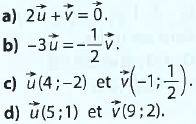
Dans chacun des cas suivants, déterminer mentalement si les vecteurs \(\overrightarrow{u}\) et \(\overrightarrow{v}\) sont colinéaires ou non.
Correction — Exercice 1
\(\overrightarrow{u}\) et \(\overrightarrow{v}\) sont colinéaires s'il existe un nombre \(k\) tel que \(\overrightarrow{v} = k\overrightarrow{u}\) (ou tel que \(\overrightarrow{u} = k\overrightarrow{v}\)).a. Oui car \(\overrightarrow{v} = -2\overrightarrow{u}\).
b. Oui car \(\overrightarrow{u} = \dfrac{1}{6}\overrightarrow{v}\).
c. Oui car \(\overrightarrow{u} = -4\overrightarrow{v}\).
d. Non car \(2 \times 1 = 2\) et \(5 \times 2 \neq 9\).
Exercice 2 : Vecteurs colinéaires 2
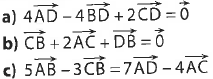
Dans chacun des cas suivants, montrer que les vecteurs \(\overrightarrow{AB}\) et \(\overrightarrow{CD}\) sont colinéaires.
Correction — Exercice 2
a. \(4\overrightarrow{AD} - 4\overrightarrow{BD} + 2\overrightarrow{CD} = \overrightarrow{0}\)\(4\overrightarrow{AD} - 4(\overrightarrow{BA} + \overrightarrow{AD}) + 2\overrightarrow{CD} = \overrightarrow{0}\)
\(4\overrightarrow{AD} - 4\overrightarrow{BA} - 4\overrightarrow{AD} + 2\overrightarrow{CD} = \overrightarrow{0}\)
\(4\overrightarrow{AB} + 2\overrightarrow{CD} = \overrightarrow{0}\)
\(4\overrightarrow{AB} = -2\overrightarrow{CD}\)
\(\overrightarrow{AB} = -\dfrac{1}{2}\overrightarrow{CD}\)
Donc \(\overrightarrow{AB}\) et \(\overrightarrow{CD}\) sont colinéaires.
b. \(\overrightarrow{CB} - 2\overrightarrow{AC} + \overrightarrow{DB} = \overrightarrow{0}\)
\(\overrightarrow{CB} - 2(\overrightarrow{AB} + \overrightarrow{BC}) + \overrightarrow{DC} + \overrightarrow{CB} = \overrightarrow{0}\)
\(2\overrightarrow{CB} - 2\overrightarrow{AB} + 2\overrightarrow{BC} + \overrightarrow{DC} = \overrightarrow{0}\)
\(\overrightarrow{DC} = 2\overrightarrow{AB}\)
Donc \(\overrightarrow{AB}\) et \(\overrightarrow{CD}\) sont colinéaires.
c. \(5\overrightarrow{AB} - 3\overrightarrow{CB} = 7\overrightarrow{AD} - 4\overrightarrow{AC}\)
\(5\overrightarrow{AB} - 3(\overrightarrow{CA} + \overrightarrow{AB}) = 7(\overrightarrow{AC} + \overrightarrow{CD}) - 4\overrightarrow{AC}\)
\(5\overrightarrow{AB} - 3\overrightarrow{CA} - 3\overrightarrow{AB} = 7\overrightarrow{AC} + 7\overrightarrow{CD} - 4\overrightarrow{AC}\)
\(2\overrightarrow{AB} + 3\overrightarrow{AC} = 3\overrightarrow{AC} + 7\overrightarrow{CD}\)
\(8\overrightarrow{AB} = 7\overrightarrow{CD}\)
\(\overrightarrow{AB} = \dfrac{7}{8}\overrightarrow{CD}\)
Donc \(\overrightarrow{AB}\) et \(\overrightarrow{CD}\) sont colinéaires.
Exercice 3 : Algorithme
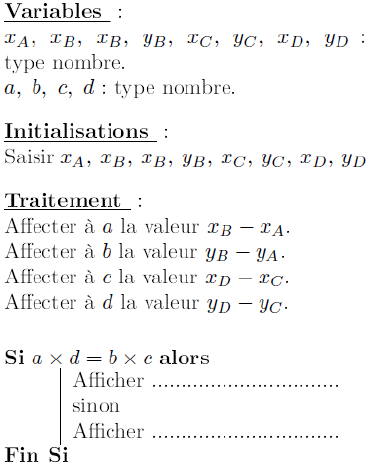
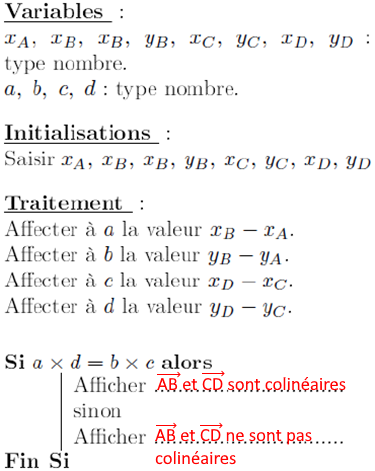
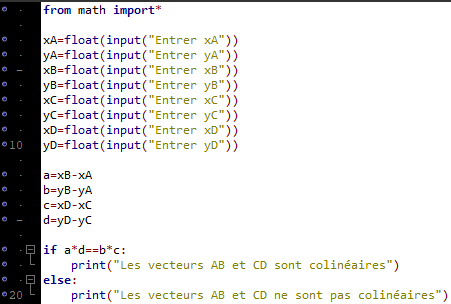
- Compléter l'algorithme suivant :
- Exécuter l'algorithme avec les points :
- \(A( - 1;1)\), \(B(2;5)\), \(C(1;4)\) et \(D( - 5; - 4)\)
- \(A( - 2;0)\), \(B(0;5)\), \(C(3;7)\) et \(D( - 2;3)\)
- Programmer cet algorithme en Python.
Correction — Exercice 3
a. \(A(-1;1)\), \(B(2;5)\), \(C(1;4)\) et \(D(-5;-4)\).
\(a = 2 - (-1) = 3\)
\(b = 5 - 1 = 4\)
\(c = -5 - 1 = -6\)
\(d = -4 - 4 = -8\)
\(ad = -24 = bc\)
"\(\overrightarrow{AB}\) et \(\overrightarrow{CD}\) sont colinéaires."
b. \(A(-2;0)\), \(B(0;5)\), \(C(3;7)\) et \(D(-2;3)\).
\(a = 0 - (-2) = 2\)
\(b = 5 - 0 = 5\)
\(c = -2 - 3 = -5\)
\(d = 3 - 7 = -4\)
\(ad = -8\) et \(bc = -25\) donc \(ad \neq bc\).
"\(\overrightarrow{AB}\) et \(\overrightarrow{CD}\) ne sont pas colinéaires."
3. Programme Python :
Exercice 4 : Point quelconque
On considère les points \(A(2;3)\) et \(B(4;1)\).Soit \(M(x;y)\) un point quelconque.
À quelle condition, portant sur \(x\) et \(y\), les vecteurs \(\overrightarrow{AM}\) et \(\overrightarrow{AB}\) sont-ils colinéaires ?
Correction — Exercice 4
\(\overrightarrow{AM}\binom{x - 2}{y - 3}\) et \(\overrightarrow{AB}\binom{4 - 2}{1 - 3} = \binom{2}{-2}\)\(\overrightarrow{AM}\) et \(\overrightarrow{AB}\) sont colinéaires
\(\Leftrightarrow \det(\overrightarrow{AM}\,;\overrightarrow{AB}) = 0\)
\(\Leftrightarrow (x - 2) \times (-2) - 2 \times (y - 3) = 0\)
\(\Leftrightarrow -2(x - 2) + 2(y - 3) = 0\)
\(\Leftrightarrow -2x + 4 + 2y - 6 = 0\)
\(\Leftrightarrow -2x + 2y - 2 = 0\)
\(\Leftrightarrow -x + y = 1\)
\(\Leftrightarrow y = x + 1\)
Conclusion : \(\overrightarrow{AM}\) et \(\overrightarrow{AB}\) sont colinéaires si et seulement si le point \(M\) s'écrit sous la forme \(M(x\,;x + 1)\).
Exercice 5 : Base du plan
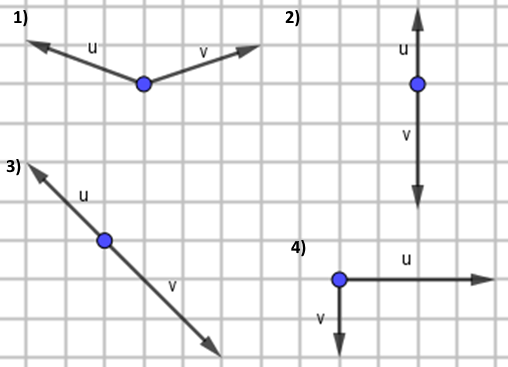
Parmi les couples de vecteurs \((\overrightarrow{u};\overrightarrow{v})\) lesquels forment une base vectorielle du plan ?
Correction — Exercice 5
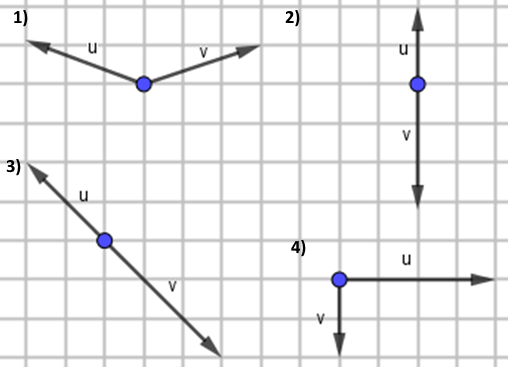
1) \(\det(\overrightarrow{u};\overrightarrow{v}) = \left| \begin{matrix} -3 & 3 \\ 1 & 1 \end{matrix} \right| = -3 \times 1 - 3 \times 1 = -6\).
Donc \((\overrightarrow{u};\overrightarrow{v})\) est une base du plan.
2) \(\det(\overrightarrow{u};\overrightarrow{v}) = \left| \begin{matrix} 0 & 0 \\ 2 & -3 \end{matrix} \right| = -3 \times 0 - 2 \times 0 = 0\).
Donc \((\overrightarrow{u};\overrightarrow{v})\) n'est pas une base du plan.
3) \(\det(\overrightarrow{u};\overrightarrow{v}) = \left| \begin{matrix} -2 & 3 \\ 2 & -3 \end{matrix} \right| = 6 - 6 = 0\).
Donc \((\overrightarrow{u};\overrightarrow{v})\) n'est pas une base du plan.
4) \(\det(\overrightarrow{u};\overrightarrow{v}) = \left| \begin{matrix} 4 & 0 \\ 0 & -2 \end{matrix} \right| = -8 - 0 = -8\).
Donc \((\overrightarrow{u};\overrightarrow{v})\) est une base du plan.
Exercice 6 : Parallélogramme
Dans un repère \((O;I;J)\) on considère les points \(A( - 3;3)\), \(B(2;1)\), \(C( - 4; - 1)\) et \(D(1; - 3)\).
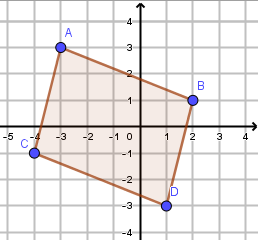
- Démontrer que le quadrilatère \(ABDC\) est un parallélogramme.
- Calculer l'aire de ce parallélogramme.
- Calculer le périmètre de ce parallélogramme.
Correction — Exercice 6
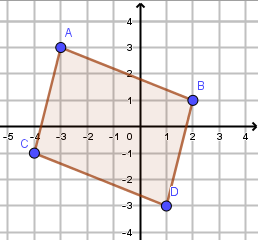
On a donc \(\overrightarrow{AB} = \overrightarrow{CD}\).
Donc \(ABDC\) est un parallélogramme.
2. \(\overrightarrow{AB}\binom{5}{-2}\) et \(\overrightarrow{AC}\binom{-4 - (-3)}{-1 - 3} = \binom{-1}{-4}\).
\(\det(\overrightarrow{AB};\overrightarrow{AC}) = \left| \begin{matrix} 5 & -1 \\ -2 & -4 \end{matrix} \right| = -20 - 2 = -22\)
\(\mathcal{A}_{ABDC} = \left| \det(\overrightarrow{AB};\overrightarrow{AC}) \right| = |-22| = 22\ u.a.\)
3. \[AB = \left\| \overrightarrow{AB} \right\| = \sqrt{5^{2} + (-2)^{2}} = \sqrt{29}\] \[AC = \left\| \overrightarrow{AC} \right\| = \sqrt{(-1)^{2} + (-4)^{2}} = \sqrt{17}\] \[\mathcal{P}_{ABDC} = 2AB + 2AC = 2\sqrt{29} + 2\sqrt{17} \approx 19\]