Exercice 1 : Tangram
Le Tangram est un jeu chinois qui est composé de différentes pièces :
- Un carré
- Un parallélogramme
- Des triangles rectangles isocèles de différentes tailles.
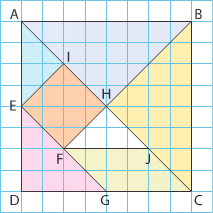
- En utilisant uniquement les points de la figure, écrire sous forme d'un seul vecteur les sommes suivantes. Justifier :
a. \(\overrightarrow{FJ} + \overrightarrow{FG}\)
b. \(\overrightarrow{EI} + \overrightarrow{EF}\)
c. \(\overrightarrow{AI} + \overrightarrow{HF}\)
d. \(\overrightarrow{IH} + \overrightarrow{JC}\) - Donner sans justifier un représentant des vecteurs suivants :
a. \(\overrightarrow{AE} + \overrightarrow{JF}\)
b. \(\overrightarrow{FJ} - \overrightarrow{IE}\)
c. \(\overrightarrow{BH} + \overrightarrow{EG} + \overrightarrow{JF}\)
d. \(\overrightarrow{HC} - \overrightarrow{AB} - \overrightarrow{BH}\) - Lire les coordonnées des vecteurs :
\(\overrightarrow{EF}\) ; \(\overrightarrow{FJ}\) ; \(\overrightarrow{BC}\) ; \(\overrightarrow{EF} + \overrightarrow{FJ}\) ; \(\overrightarrow{BC} - \overrightarrow{FJ}\) - Placer les points :
- \(K\) tel que \(\overrightarrow{HK} = \overrightarrow{FJ} + \overrightarrow{DE}\)
- \(L\) tel que \(\overrightarrow{AL} = \overrightarrow{HC} - \overrightarrow{EI}\)
- \(M\) tel que \(\overrightarrow{MH} = \overrightarrow{HJ} + \overrightarrow{HF}\)
Correction — Exercice 1
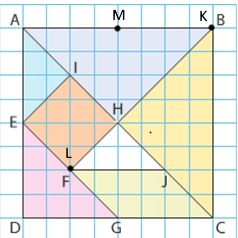
b. \(\overrightarrow{EH}\) car \(EIHF\) est un parallélogramme.
c. \(\overrightarrow{HF} = \overrightarrow{IE}\) (\(HFEI\) parallélogramme). Donc \(\overrightarrow{AI} + \overrightarrow{HF} = \overrightarrow{AI} + \overrightarrow{IE} = \overrightarrow{AE}\).
d. \(\overrightarrow{IH} + \overrightarrow{JC} = \overrightarrow{IH} + \overrightarrow{HJ} = \overrightarrow{IJ}\).
2) a. \(\overrightarrow{BH}\) ou \(\overrightarrow{HD}\)
b. \(\overrightarrow{DJ}\)
c. \(\overrightarrow{BG}\)
d. \(\overrightarrow{HH} = \overrightarrow{0}\)
3) \(\overrightarrow{EF} = \binom{2}{-2}\) ; \(\overrightarrow{FJ} = \binom{4}{0}\) ; \(\overrightarrow{BC} = \binom{0}{-8}\).
\(\overrightarrow{EF} + \overrightarrow{FJ} = \binom{2 + 4}{-2 + 0} = \binom{6}{-2}\)
\(\overrightarrow{BC} - \overrightarrow{FJ} = \binom{0 - 4}{-8 - 0} = \binom{-4}{-8}\)
4) a. \(K = B\)
b. \(L = F\)
c. \(M\) (voir figure)
Exercice 2 : Pavage
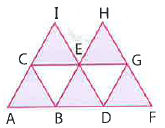
Cette figure est constituée d'un assemblage de triangles équilatéraux. Compléter chacune des égalités suivantes en utilisant un des points de la figure.
- \(\overrightarrow{AB} + \overrightarrow{EH} = \overrightarrow{A\ldots}\)
- \(\overrightarrow{CE} + \overrightarrow{FB} = \overrightarrow{E\ldots}\)
- \(\overrightarrow{AH} + \overrightarrow{ID} = \overrightarrow{A\ldots}\)
- \(\overrightarrow{ID} + \overrightarrow{BC} + \overrightarrow{EC} = \overrightarrow{G\ldots}\)
- \(\overrightarrow{HE} + \overrightarrow{CB} + \overrightarrow{DF} + \overrightarrow{\ldots I} = \overrightarrow{0}\)
- \(\overrightarrow{AC} + \overrightarrow{EF} - \overrightarrow{\ldots G} = \overrightarrow{CH}\)
Correction — Exercice 2
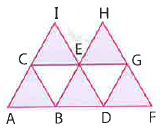
b. \(\overrightarrow{CE} + \overrightarrow{FB} = \overrightarrow{E\mathbf{C}}\)
c. \(\overrightarrow{AH} + \overrightarrow{ID} = \overrightarrow{A\mathbf{F}}\)
d. \(\overrightarrow{ID} + \overrightarrow{BC} + \overrightarrow{EC} = \overrightarrow{G\mathbf{D}}\)
e. \(\overrightarrow{HE} + \overrightarrow{CB} + \overrightarrow{DF} + \overrightarrow{\mathbf{H}I} = \overrightarrow{0}\)
f. \(\overrightarrow{AC} + \overrightarrow{EF} - \overrightarrow{\mathbf{H}G} = \overrightarrow{CH}\)
Exercice 3 : Segment

- Placer les points \(F\), \(G\) et \(H\) tel que :
- \(\overrightarrow{AF} = \overrightarrow{AB} + \overrightarrow{DE}\)
- \(\overrightarrow{DG} + \overrightarrow{EG} = \overrightarrow{0}\)
- \(\overrightarrow{HD} + \overrightarrow{AC} + \overrightarrow{DA} = \overrightarrow{DE}\)
- Compléter par le point qui convient :
- \(\overrightarrow{CD} + \overrightarrow{ED} = \overrightarrow{\ldots A}\)
- \(\overrightarrow{BC} + \overrightarrow{C\ldots} + \overrightarrow{AB} = \overrightarrow{0}\)
Correction — Exercice 3

b. \(\overrightarrow{BC} + \overrightarrow{CA} + \overrightarrow{AB} = \overrightarrow{0}\)
Exercice 4 : Représenter la somme 1
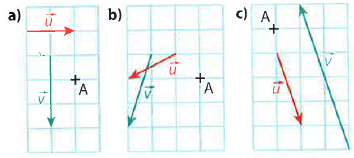
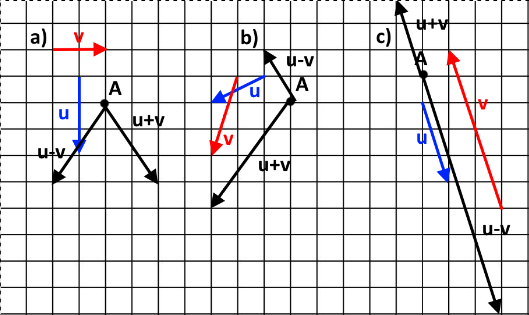
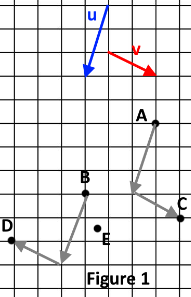
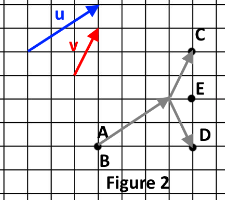
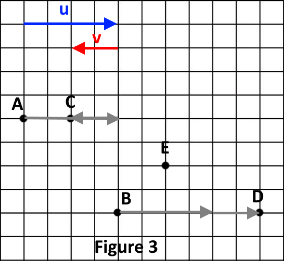
Dans chacun des cas, reproduire la figure puis construire le représentant d'origine \(A\) des vecteurs \(\overrightarrow{u} + \overrightarrow{v}\) et \(\overrightarrow{u} - \overrightarrow{v}\).
Correction — Exercice 4
Exercice 5 : Représenter la somme 2
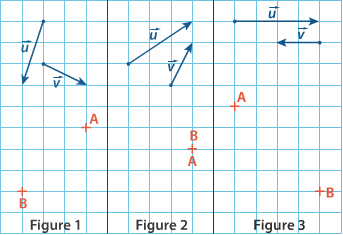
Dans chacun des cas, reproduire la figure sur un quadrillage puis construire :
- Le point \(C\) tel que \(\overrightarrow{AC} = \overrightarrow{u} + \overrightarrow{v}\)
- Le point \(D\) tel que \(\overrightarrow{BD} = \overrightarrow{u} - \overrightarrow{v}\)
- Le point \(E\) tel que \(\overrightarrow{EC} + \overrightarrow{ED} = \overrightarrow{0}\)
Correction — Exercice 5
Exercice 6 : Représenter la somme 3
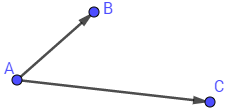
Construire le vecteur \(\overrightarrow{AB} + \overrightarrow{AC}\).
Correction — Exercice 6
On construit le parallélogramme \(ABDC\).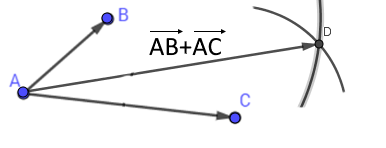
Exercice 7 : Représenter la somme 4
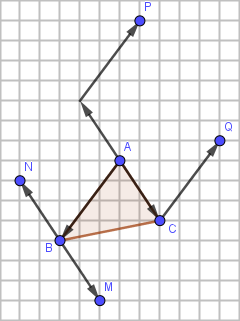
Soit \(ABC\) un triangle.
- Placer les points \(M\) et \(N\) tel que :
\(\overrightarrow{AM} = \overrightarrow{AB} + \overrightarrow{AC}\) et \(\overrightarrow{AN} = \overrightarrow{AB} - \overrightarrow{AC}\) - Placer les points \(P\) et \(Q\) tel que :
\(\overrightarrow{AP} = \overrightarrow{CA} + \overrightarrow{BA}\) et \(\overrightarrow{AQ} = \overrightarrow{AC} - \overrightarrow{AB}\)
Correction — Exercice 7
Exercice 8 : Représenter la somme 5
Construire un carré \(ABCD\) de centre \(O\) et de côté \(4\ cm\), puis à l'aide du compas, construire le représentant du vecteur :
- \(\overrightarrow{u} = \overrightarrow{AO} + \overrightarrow{AB}\) d'origine \(A\)
- \(\overrightarrow{v} = \overrightarrow{DA} + \overrightarrow{CO}\) d'origine \(D\)
- \(\overrightarrow{w} = \overrightarrow{AB} + \overrightarrow{AD} + \overrightarrow{CO}\) d'origine \(C\)
Correction — Exercice 8
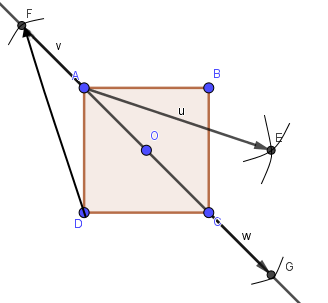
b. On trace la diagonale \((AC)\) et on reporte la distance \(CO\) à partir de \(A\).
c. \(\overrightarrow{AB} + \overrightarrow{AD} = \overrightarrow{AC}\) car \(ABCD\) est un parallélogramme.
Donc \(\overrightarrow{w} = \overrightarrow{AC} + \overrightarrow{CO} = \overrightarrow{AO}\). Donc on reporte la distance \(AO\) sur la diagonale à partir de \(C\).
Exercice 9 : Relation de Chasles 1
À l'aide de la relation de Chasles, simplifier les écritures des vecteurs \(\overrightarrow{u}\), \(\overrightarrow{v}\) et \(\overrightarrow{w}\).
- \(\overrightarrow{u} = \overrightarrow{AB} + \overrightarrow{BC} + \overrightarrow{CA}\)
- \(\overrightarrow{v} = \overrightarrow{AB} - \overrightarrow{AC} + \overrightarrow{BC} - \overrightarrow{BA}\)
- \(\overrightarrow{w} = \overrightarrow{MA} - \overrightarrow{MB} - \overrightarrow{AB}\)
Correction — Exercice 9
a. \(\overrightarrow{u} = \overrightarrow{AB} + \overrightarrow{BC} + \overrightarrow{CA} = \overrightarrow{AA} = \overrightarrow{0}\)b. \(\overrightarrow{v} = \overrightarrow{AB} - \overrightarrow{AC} + \overrightarrow{BC} - \overrightarrow{BA}\)
\(= \overrightarrow{AB} + \overrightarrow{CA} + \overrightarrow{BC} + \overrightarrow{AB}\)
\(= \overrightarrow{AB} + \overrightarrow{BC} + \overrightarrow{CA} + \overrightarrow{AB}\)
\(= \overrightarrow{AA} + \overrightarrow{AB} = \overrightarrow{AB}\)
c. \(\overrightarrow{w} = \overrightarrow{MA} - \overrightarrow{MB} - \overrightarrow{AB}\)
\(\overrightarrow{w} = \overrightarrow{MA} + \overrightarrow{BM} + \overrightarrow{BA}\)
\(\overrightarrow{w} = \overrightarrow{BM} + \overrightarrow{MA} + \overrightarrow{BA}\)
\(\overrightarrow{w} = \overrightarrow{BA} + \overrightarrow{BA} = 2\overrightarrow{BA}\)
Exercice 10 : Relation de Chasles 2
Simplifier les écritures suivantes :
- \(\overrightarrow{AR} + \overrightarrow{BA} + \overrightarrow{RC}\)
- \(\overrightarrow{OW} + \overrightarrow{LO} + \overrightarrow{XL}\)
- \(\overrightarrow{PR} - \overrightarrow{PG} + \overrightarrow{RF}\)
- \(\overrightarrow{AB} - \overrightarrow{CD} - \overrightarrow{AC}\)
Correction — Exercice 10
a. \(\overrightarrow{AR} + \overrightarrow{BA} + \overrightarrow{RC} = \overrightarrow{BA} + \overrightarrow{AR} + \overrightarrow{RC} = \overrightarrow{BC}\)b. \(\overrightarrow{OW} + \overrightarrow{LO} + \overrightarrow{XL} = \overrightarrow{XL} + \overrightarrow{LO} + \overrightarrow{OW} = \overrightarrow{XW}\)
c. \(\overrightarrow{PR} - \overrightarrow{PG} + \overrightarrow{RF} = \overrightarrow{GP} + \overrightarrow{PR} + \overrightarrow{RF} = \overrightarrow{GF}\)
d. \(\overrightarrow{AB} - \overrightarrow{CD} - \overrightarrow{AC} = \overrightarrow{DC} + \overrightarrow{CA} + \overrightarrow{AB} = \overrightarrow{DB}\)
Exercice 11 : Dans un triangle
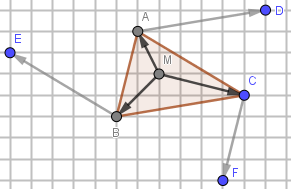
\(ABC\) est un triangle et \(M\) un point quelconque intérieur au triangle.
- Placer les points \(D\), \(E\) et \(F\) tel que :
- \(\overrightarrow{MD} = \overrightarrow{MA} + \overrightarrow{BC}\)
- \(\overrightarrow{ME} = \overrightarrow{MB} + \overrightarrow{CA}\)
- \(\overrightarrow{MF} = \overrightarrow{MC} + \overrightarrow{AB}\)
- Démontrer que : \[\overrightarrow{MD} + \overrightarrow{ME} + \overrightarrow{MF} = \overrightarrow{MA} + \overrightarrow{MB} + \overrightarrow{MC}\]
Correction — Exercice 11
\(= \overrightarrow{MA} + \overrightarrow{BC} + \overrightarrow{MB} + \overrightarrow{CA} + \overrightarrow{MC} + \overrightarrow{AB}\)
\(= \overrightarrow{MA} + \overrightarrow{MB} + \overrightarrow{MC} + \overrightarrow{BC} + \overrightarrow{CA} + \overrightarrow{AB}\)
\(= \overrightarrow{MA} + \overrightarrow{MB} + \overrightarrow{MC} + \overrightarrow{BB}\)
\(= \overrightarrow{MA} + \overrightarrow{MB} + \overrightarrow{MC}\)
Exercice 12 : Coordonnées - Calcul mental
Dans un repère, on considère les vecteurs suivants :\(\overrightarrow{AB}\binom{1}{3}\), \(\overrightarrow{CD}\binom{- 2}{4}\) et \(\overrightarrow{EF}\binom{0}{10}\).
- Calculer mentalement les coordonnées des vecteurs \(\overrightarrow{u} = \overrightarrow{AB} + \overrightarrow{CD}\) et \(\overrightarrow{v} = \overrightarrow{EF} + \overrightarrow{BA}\).
- Que peut-on en déduire sur \(\overrightarrow{u}\) et \(\overrightarrow{v}\) ?
Correction — Exercice 12
\(\overrightarrow{AB}\binom{1}{3}\), \(\overrightarrow{CD}\binom{-2}{4}\) et \(\overrightarrow{EF}\binom{0}{10}\).1. \(\overrightarrow{u} = \binom{1 - 2}{3 + 4} = \binom{-1}{7}\) et \(\overrightarrow{v} = \binom{0 - 1}{10 - 3} = \binom{-1}{7}\).
2. Ils sont égaux.
Exercice 13 : Système à l'équilibre
En physique une force est représentée par un vecteur. Le système est équilibré lorsque la somme des forces qui s'exercent sur ce système est égale au vecteur nul \(\overrightarrow{0}\).
- Lire les coordonnées des vecteurs \(\overrightarrow{F_{1}}\), \(\overrightarrow{F_{2}}\) et \(\overrightarrow{F_{3}}\).
- Calculer \(\overrightarrow{F_{1}} + \overrightarrow{F_{2}} + \overrightarrow{F_{3}}\).
- Que peut-on en déduire pour ce système ?
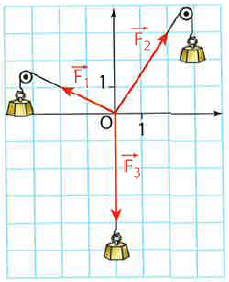
Correction — Exercice 13
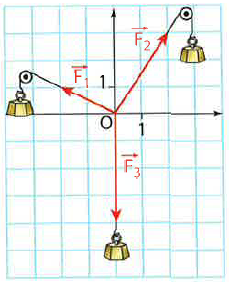
2) \(\overrightarrow{F_{1}} + \overrightarrow{F_{2}} + \overrightarrow{F_{3}} = \binom{-2}{1} + \binom{2}{3} + \binom{0}{-4} = \binom{-2 + 2 + 0}{1 + 3 - 4} = \binom{0}{0} = \overrightarrow{0}\)
3) Le système est à l'équilibre.
Exercice 14 : Calcul de coordonnées
Dans un repère du plan, on considère les points \(A(1;3)\), \(B(0;4)\) et \(C(5;0)\). Déterminer par le calcul les coordonnées des points :
- \(H\) tel que \(\overrightarrow{AH} + \overrightarrow{BH} = \overrightarrow{AC}\)
- \(M\) tel que \(\overrightarrow{MA} + \overrightarrow{MB} + \overrightarrow{MC} = \overrightarrow{0}\)
- \(D\) tel que \(ABCD\) soit un parallélogramme.
Correction — Exercice 14
\(A(1;3)\), \(B(0;4)\) et \(C(5;0)\).1. On cherche le point \(H(x_{H};y_{H})\) tel que :
\(\binom{x_{H} - 1}{y_{H} - 3} + \binom{x_{H}}{y_{H} - 4} = \binom{5 - 1}{0 - 3}\)
\(\left\{ \begin{array}{l} 2x_{H} - 1 = 4 \\ 2y_{H} - 7 = -3 \end{array} \right.\) d'où \(\left\{ \begin{array}{l} x_{H} = 2{,}5 \\ y_{H} = 2 \end{array} \right.\)
On a donc \(H(2{,}5\,;2)\).
2. On cherche le point \(M(x;y)\) tel que :
\(\binom{x - 1}{y - 3} + \binom{x}{y - 4} + \binom{x - 5}{y} = \binom{0}{0}\)
\(\left\{ \begin{array}{l} 3x - 6 = 0 \\ 3y - 7 = 0 \end{array} \right.\) d'où \(\left\{ \begin{array}{l} x = 2 \\ y = \dfrac{7}{3} \end{array} \right.\)
On a donc \(M\left(2\,;\dfrac{7}{3}\right)\).
3. \(ABCD\) est un parallélogramme \(\Longleftrightarrow \overrightarrow{AB} = \overrightarrow{DC}\).
\(\binom{0 - 1}{4 - 3} = \binom{x_{D} - 5}{y_{D}}\)
\(\binom{-1}{1} = \binom{x_{D} - 5}{y_{D}}\)
\(\left\{ \begin{array}{l} x_{D} = -1 + 5 = 4 \\ y_{D} = 1 \end{array} \right.\)
On a donc \(D(4;1)\).
Exercice 15 : Bateau
L'embarcation est en panne. Va-t-elle s'échouer sur le récif ?
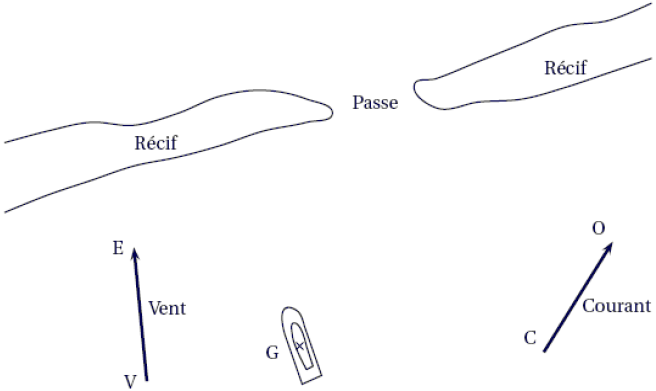
Correction — Exercice 15
Avec le compas on construit d'abord le parallélogramme \(EVGH\) puis \(OCDI\).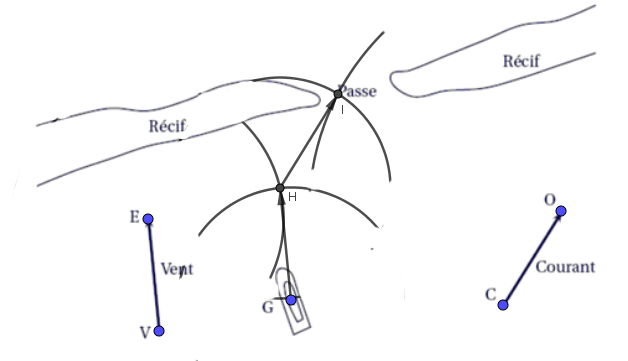
Exercice 16 : Dans l'espace
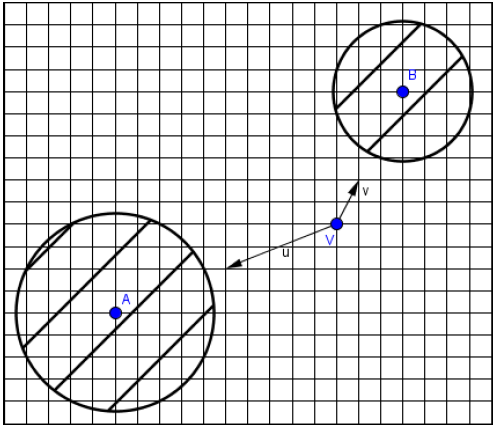
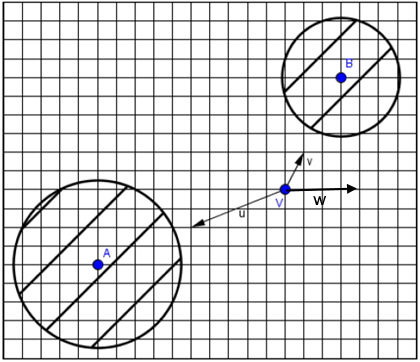
Un vaisseau spatial, à l'arrêt dans l'espace, est soumis aux forces d'attraction de deux astres A et B. Dans quelle direction doit-il déclencher son moteur pour rester immobile ?
Correction — Exercice 16
On a \(\overrightarrow{u} = \binom{-5}{-2}\) et \(\overrightarrow{v} = \binom{1}{2}\).Le vaisseau doit exercer une force \(\overrightarrow{w}\) telle que : \(\overrightarrow{u} + \overrightarrow{v} + \overrightarrow{w} = \overrightarrow{0}\) donc telle que \(\overrightarrow{w} = - \overrightarrow{u} - \overrightarrow{v}\).
On a donc \(\overrightarrow{w} = \binom{5 - 1}{2 - 2} = \binom{4}{0}\).
Exercice 17 : Traversée
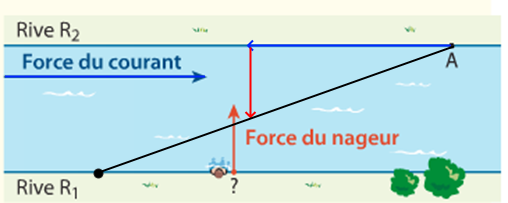
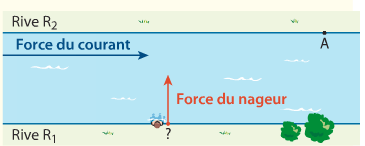
Un nageur se trouve sur la rive \(R_{1}\) d'une rivière dont les berges sont parallèles. De quel endroit doit-il quitter cette rive pour atteindre la balise située en \(A\) sur la rive \(R_{2}\) ?
Correction — Exercice 17
Le nageur va dans la direction du vecteur force obtenu en additionnant la force du courant et la force du nageur. On part donc du point d'arrivée \(A\) et on cherche le vecteur opposé à ce vecteur. Puis on trace la droite qui donne la direction de ce vecteur.